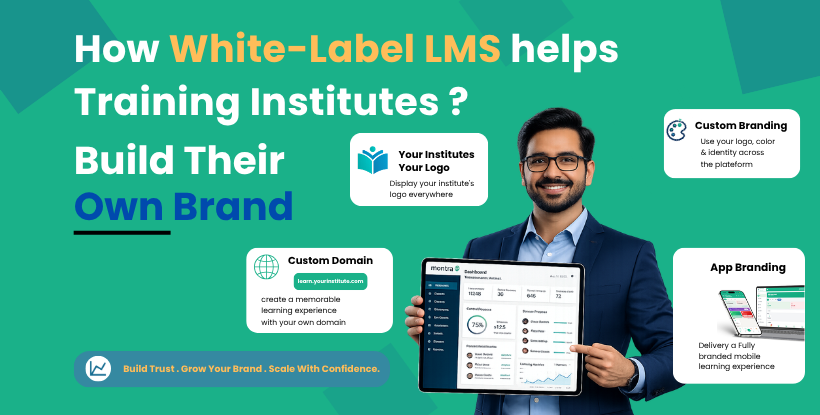
How White-Label LMS Helps Training Institutes Build Their Own Brand ?
A White-Label Learning Management System (LMS) is a fully customizable online learning platform that allows training institutes to deliver courses under their own brand instead of the software provider's. Everything learners interact with including the login page, custom domain, learner dashboard, emails, certificates, and mobile experience can be tailored to reflect the institute's unique identity.
For modern training providers, branding extends far beyond a logo. Every digital interaction shapes how learners perceive the quality, professionalism, and credibility of an institution. A white-label LMS ensures that each stage of the learning journey consistently reinforces the institute's brand, helping organizations build trust, improve learner engagement, and establish a stronger presence in an increasingly competitive education market.
Beyond visual customization, a white-label LMS supports long-term business growth. It enables institutes to create a seamless learning experience, strengthen brand recognition, enhance the value of certifications, and scale online training programs without promoting a third-party platform. Whether serving students, professionals, or corporate clients, a white-label LMS gives organizations complete ownership of their digital learning ecosystem.
Introduction
The success of an online training institute depends on more than delivering quality courses. In today's digital-first learning environment, the overall learner experience plays an equally important role in building a strong and recognizable brand.
Think about every touchpoint a learner encounters—from registering for a course and accessing lessons to receiving notifications, completing assessments, and downloading certificates. Each interaction contributes to how the institute is remembered. If these experiences are branded with a third-party LMS provider, the institute loses valuable opportunities to reinforce its own identity.
A White-Label Learning Management System (LMS) solves this challenge by allowing training institutes to create a learning environment that feels entirely their own. Instead of directing attention to the software vendor, every element of the platform reflects the institute's branding, creating a consistent, professional, and trustworthy experience for learners.
What Is a White-Label LMS?
A White-Label LMS is a learning management platform designed to be fully rebranded so it appears as the institute's own software. Rather than displaying the LMS provider's identity, organizations can personalize the platform to match their visual identity and business requirements.
Most white-label LMS solutions allow institutions to customize:
* Company logo and favicon
* Brand colors and typography
* Custom domain name (for example, **learn.yourinstitute.com**)
* Login and registration pages
* Learner dashboard
* Mobile application branding
* Automated email templates
* Digital certificates
* Reports and analytics
* User interface and navigation
The result is a seamless learning experience where learners engage only with the institute's brand, creating greater familiarity and trust throughout their educational journey.
Why Branding Matters in Online Learning?
Branding is no longer limited to websites, brochures, or advertisements. In online education, the learning platform itself becomes the institution's digital campus and one of its most powerful brand assets.
Every lesson completed, assessment submitted, progress update received, or certificate earned shapes how learners perceive the organization. A consistent and professionally branded experience communicates credibility, reliability, and attention to detail qualities that influence whether learners enroll, complete courses, or recommend the institute to others.
Institutions that invest in strong digital branding are better positioned to:
* Build learner confidence from the first interaction.
* Increase brand recognition across multiple courses and programs.
* Differentiate themselves in a competitive education market.
* Create a premium learning experience that encourages repeat enrollments.
* Develop lasting relationships with students, professionals, and corporate clients.