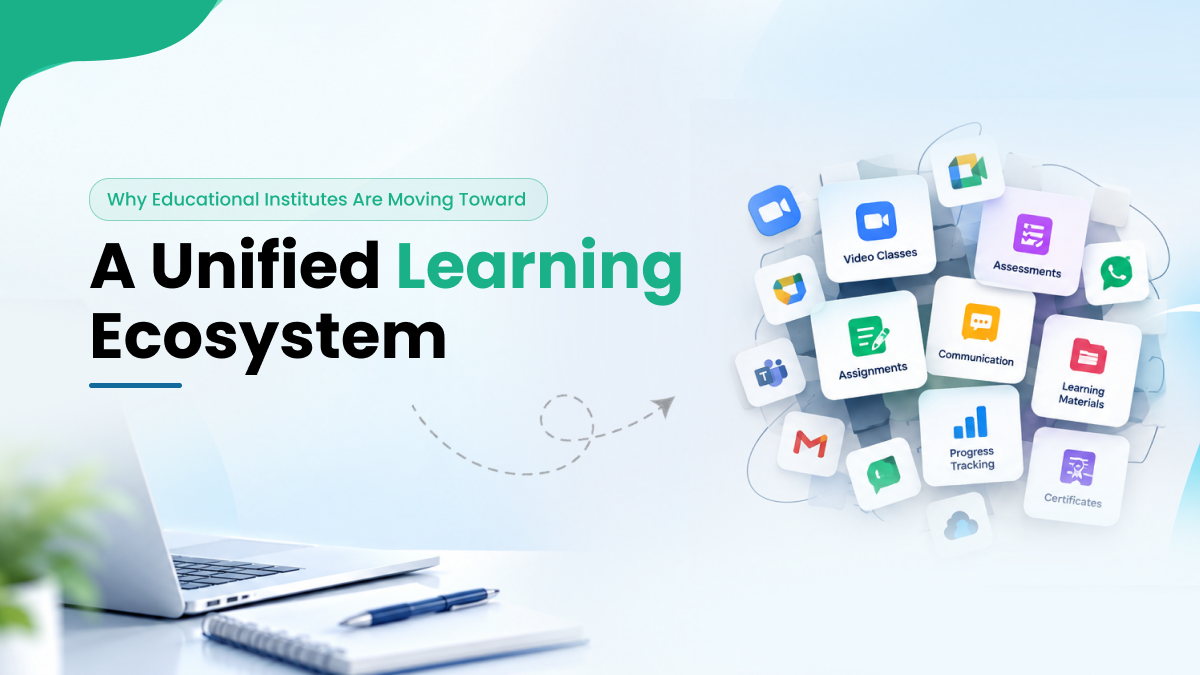
Why Educational Institutes Are Moving Toward a Unified Learning Ecosystem?
Education is no longer limited to the classroom.
Today, students may learn through recorded courses, attend live classes, complete online assignments, take assessments, participate in discussions, and track their progress all from different digital platforms.
For educational institutes, this digital shift creates an important question:
Should every part of the learning experience be managed through a separate tool, or can everything work together within one connected system?
This is where a modern Learning Management System (LMS) becomes increasingly valuable.
Rather than using separate platforms for courses, live classes, assessments, communication, and learner management, institutes are moving toward unified learning ecosystems that bring these activities together in one place.
What Is a Unified Learning Ecosystem?
A unified learning ecosystem is a connected digital environment where different parts of the learning journey work together.
Instead of treating online courses, live classes, assignments, examinations, student progress, and certificates as separate activities, an LMS connects them into a structured learning experience.
For an educational institute, this can mean:
Course Content → Live Learning → Assignments → Assessments → Progress Tracking → Certification
Everything becomes part of one continuous learner journey.
This approach can make digital education easier to manage for administrators and instructors while giving students a more organized way to access their learning resources.
The Hidden Challenge of Using Multiple Education Platforms
When institutes first begin offering digital learning, using several individual tools can seem practical.
One platform may be used for video content. Another may handle online tests. Live classes might happen somewhere else, while assignments and communication are managed through separate applications.
As the number of students and courses grows, however, this fragmented approach can become harder to manage.
Students Experience a Disconnected Learning Journey
Students may have to remember different accounts, links, applications, and platforms for different activities.
Instead of concentrating on learning, they may spend unnecessary time finding where a particular class, assignment, test, or resource is located.
A centralized LMS can bring these learning activities together so students have a clearer digital learning environment.
Educators Manage More Than Just Teaching
Modern instructors are often responsible for more than delivering lessons.
They may need to upload course materials, prepare assessments, manage assignments, conduct live sessions, monitor student activity, and review performance.
Managing these activities across multiple systems can add administrative work.
An integrated LMS provides a centralized environment where instructors can organize much of this work more efficiently.
Student Information Can Become Scattered
When learning data is distributed across several platforms, it becomes harder to understand the complete student journey.
For example, course participation might exist in one system while assessment results are stored somewhere else.
A connected learning platform can bring learning activities and performance information together, providing institutes with a more complete view of learner engagement.
An LMS Is More Than a Video-Course Platform
One of the biggest misconceptions about an LMS is that it is simply a place to upload recorded videos. A modern Learning Management System for educational institutes can support much more than video-based learning.
Depending on the platform, an institute can manage:
- Online courses
- Recorded lessons
- Live classes
- Assignments
- Quizzes and examinations
- Mock tests
- Discussion forums
- Learning materials
- Student progress
- Certificates
- Payments
- Reports and analytics
- Mobile learning
This transforms an LMS from a content repository into a broader digital learning infrastructure.
Creating a Connected Student Journey
A strong digital learning experience should feel continuous.
Imagine a student enrolling in a course.
They access their course materials, attend a scheduled live class, complete an assignment, take a quiz, review their performance, and continue to the next module.
When these activities are connected through one platform, the learning journey becomes easier to follow.
For institutes, this also creates a structured framework for designing courses and monitoring learner participation.
The goal is not simply to digitize existing classroom activities.
The goal is to create a better-connected learning experience.
Mobile Learning Is No Longer an Optional Add-On
Students are increasingly accessing educational content through smartphones.
For many learners, mobile devices are not a secondary way of learning—they are one of their primary digital learning tools.
This makes mobile accessibility an important consideration when selecting an LMS.
A modern learning platform can extend the institute's digital classroom beyond the desktop through dedicated mobile applications.
With a branded Android and iOS application, institutes can provide learners with convenient access to courses, learning materials, assessments, live sessions, and other platform features.
This also allows the institute to maintain a consistent digital identity across its website and mobile experience.
AI Is Adding a New Layer to Digital Learning
Artificial intelligence is also beginning to change how educational content is created and managed.
Creating quizzes, practice questions, course structures, and supporting learning materials can take considerable time.
AI-assisted LMS features can help educators generate initial content that can then be reviewed, edited, and customized by instructors.
This is an important distinction.
AI should support educators—not replace educational expertise.
When used appropriately, AI can reduce repetitive tasks and allow educators to spend more time on teaching, mentoring, feedback, and improving the learning experience.
A Modern LMS Supports Different Teaching Models
Every educational institute has a different teaching approach.
A competitive-exam academy may depend heavily on mock tests and practice questions.
A professional training institute may focus on structured courses and certificates.
A coaching center may combine live classes with recorded lessons and assignments.
A flexible LMS should be capable of supporting these different approaches.
Institutes can combine multiple learning methods, including:
Recorded Learning
Provide students with structured access to video lessons and digital learning materials.
Live Learning
Connect learners with instructors through live online classes.
Assessment-Based Learning
Use quizzes, examinations, assignments, and mock tests to evaluate understanding.
Collaborative Learning
Provide discussion forums and other tools that allow learners to interact and participate.
Certification
Issue digital certificates after learners complete defined courses or learning requirements.
The result is a more flexible learning environment that can adapt to the institute's educational model.
Why Customization Matters?
Not every educational organization operates in the same way.
An institute may have its own:
- Brand identity
- Course structure
- Student registration process
- Learning model
- Assessment requirements
- User roles
- Payment workflow
- Reporting requirements
This is why customization matters when choosing an LMS.
A customized LMS can be designed around the institute's requirements instead of forcing the organization to completely change its existing workflow.
Custom branding, domain configuration, integrations, permissions, and platform features can help an institute build a digital learning environment that feels like its own.
Building a Stronger Digital Education Brand
Digital learning is also becoming part of an institute's brand identity.
Students do not only evaluate an institute based on its physical classrooms or instructors. Their experience with the institute's website, mobile application, course interface, communication, assessments, and digital support can also influence how they perceive the organization.
A branded LMS allows educational institutes to create a more consistent digital presence.
Instead of directing students through a collection of unrelated third-party tools, the institute can provide a centralized learning experience under its own identity.
This can be particularly useful for institutes looking to expand their online courses, reach students beyond their physical location, or develop a long-term digital education strategy.
Where Mantra LMS Fits In?
Mantra LMS is built for educational institutes that want to create a complete digital learning environment rather than simply host online videos.
The platform brings together key components of digital education, including:
Course Management for organizing and delivering structured learning content
Live Classes through integrations with platforms such as Zoom, Google Meet, and Microsoft Teams
Exams & Quizzes for evaluating learner understanding
Assignments for structured learning activities
Discussion Forums for learner interaction
AI-Powered Learning Tools to support content and assessment workflows
Protected Content Delivery with technologies such as H5P and SCORM support
Progress Tracking and Reports for monitoring learning activities
Digital Certificates for course completion
Mobile Applications for Android and iOS
Custom Branding to create an institute-specific learning environment
Migration Support for institutes moving from existing systems
By bringing these capabilities together, Mantra LMS helps institutes build a more connected digital learning ecosystem around their own brand.
The Future of Digital Education Is Connected
The evolution of online education is not simply about moving classroom content onto the internet.
It is about connecting the different parts of the learning experience.
Students want convenient access to learning.
Educators need efficient tools.
Administrators need better visibility.
Institutes need scalable digital infrastructure.
A unified LMS can connect these requirements within one environment.
Instead of managing a collection of disconnected tools, educational organizations can build a centralized digital ecosystem where learning, assessment, communication, progress, and certification work together.
Final Thoughts
As educational institutes continue to adopt digital learning, the focus is shifting from simply offering online classes to creating complete digital learning experiences.
Using multiple platforms may solve individual requirements, but a unified Learning Management System can connect those requirements into a structured ecosystem.
For institutes planning to expand their online presence, launch digital courses, improve learner engagement, or build a branded education platform, choosing the right LMS can become an important part of their long-term digital strategy.
The future of digital education is not about having more tools. It is about making the right tools work together.
With its combination of learning management, live classes, assessments, AI-assisted features, mobile applications, analytics, customization, and content delivery, Mantra LMS provides educational institutes with a foundation for building that connected learning experience.