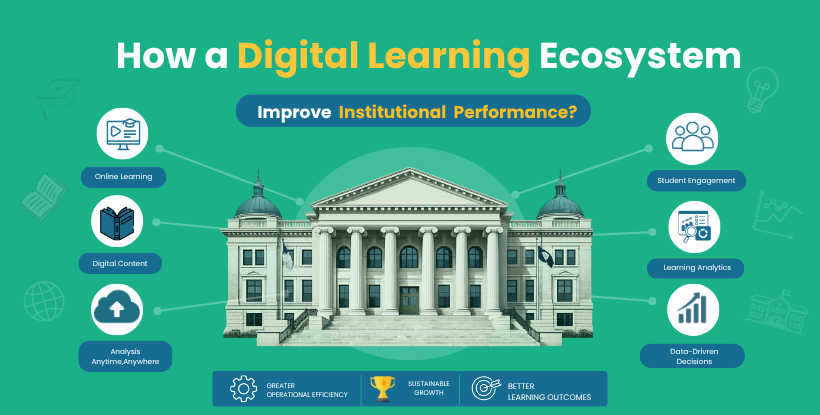
A Digital Learning Ecosystem is a connected educational environment where tools such as Learning Management Systems (LMS), virtual classrooms, digital content platforms, analytics systems, teachers, and students operate together in an integrated structure.
It shifts traditional education toward a technology-driven, data-informed, and interaction-focused learning approach, enhancing how institutions deliver instruction, manage academic operations, and monitor student progress.
Challenges in Traditional Education Systems
Conventional education systems typically face several limitations, including:
- Low student engagement with passive learning methods
- Time-consuming and error-prone manual administration
- Lack of real-time monitoring of academic performance
- Limited access to learning resources outside the classroom
- Inefficient communication between teachers, students, and parents
- Late detection of students who are struggling academically
These issues collectively reduce institutional efficiency and learning effectiveness.
How a Digital Learning Ecosystem Improves Performance?
1. Enhances Teaching and Learning Delivery
A digital ecosystem supports interactive and multimedia-rich instruction, including videos, e-notes, quizzes, and virtual demonstrations. LMS platforms help organize lessons and provide instant feedback.
This leads to improved understanding, clearer concepts, and better knowledge retention.
2. Increases Student Engagement and Participation
Digital learning encourages active participation through live classes, gamified learning, real-time quizzes, and collaborative activities.
This transforms learners from passive receivers into active participants, boosting interest and motivation.
3. Supports Data-Driven Academic Monitoring
Digital systems continuously track student data such as:
- Attendance records
- Exam and assessment results
- Learning progress
- Participation levels
This helps institutions identify weak students early and apply targeted academic support.
4. Automates Administrative Processes
Routine institutional tasks are streamlined through automation, including:
- Attendance tracking
- Grade processing
- Student record management
- Report generation
This improves efficiency, accuracy, and reduces administrative workload.
5. Enables Flexible and Remote Learning
Students can access learning materials anytime through digital devices, allowing learning beyond the classroom.
This supports flexible study schedules, revision opportunities, and remote accessibility.
6. Improves Communication and Collaboration
- Digital ecosystems enhance communication among:
- Teachers and students
- Institutions and parents
- Students and peers
This ensures better coordination, transparency, and timely information sharing.
7. Strengthens Institutional Performance
Overall, these improvements lead to:
- Higher academic achievement
- Increased student engagement
- More efficient institutional operations
- Data-informed decision-making
- Stronger digital transformation in education systems