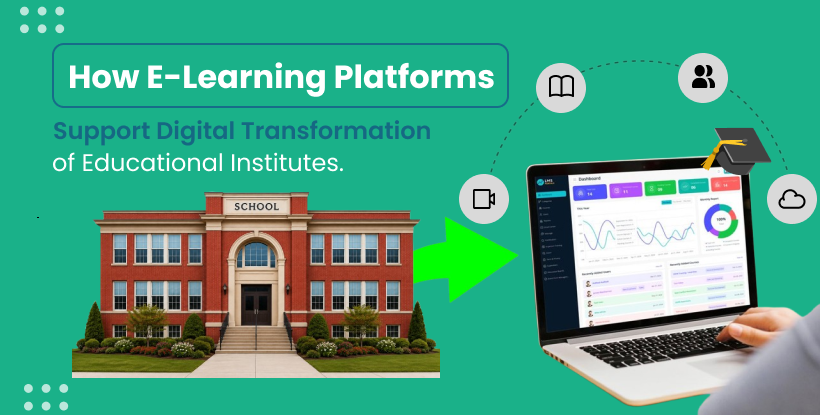
Digital tools aren't a nice to have anymore for schools, colleges, and training centers they're becoming essential. Institutes still stuck with paper registers and manual grading are losing ground to ones offering quicker, more flexible learning options. The force behind this change is the e-learning platform.
What Is Digital Transformation for Educational Institutes?
At its core, it's about restructuring how an institute functions going beyond just having a website, and actually moving teaching, administrative work, and student engagement onto digital tools. That includes admissions, attendance, content delivery, assessments, and communication.
Most of this shift runs through a Learning Management System (LMS).
Why E-Learning Platforms Matter Here?
- Pull content, attendance, grading, and communication into a single system
- Help institutes reach learners outside their physical campus
- Convert raw attendance and performance data into insights that can actually be acted on
- Reduce the repetitive admin load on staff and teachers
- Meet what today's learners expect — mobile access, fast feedback, digital records
Key Ways These Platforms Drive Transformation
1. One Place for Content
Rather than scattered handouts, course materials sit in a single searchable system that teachers and students can pull up anytime.
2. Less Manual Admin Work
Attendance, grading, fee reminders, and reporting shift from manual effort to automated processes — freeing up staff time.
3. Decisions Backed by Data
Dashboards flag where students are falling behind and which courses need attention — the kind of visibility that's hard to get by hand.
4. Reach That Isn't Tied to a Building
Hybrid or fully online programs let an institute teach learners in other cities or countries without opening a new physical location.
5. Smoother Communication
Messaging and parent/guardian portals replace the back-and-forth of phone calls and printed notices.
6. Assessment That Scales
Auto-graded quizzes and plagiarism checks make it possible to evaluate large groups of students both quickly and consistently.
Roadblocks Institutes Commonly Run Into
- Staff pushback against adopting new tools
- The work involved in migrating existing content and records over
- Budget hesitation — even though cloud-based LMS is typically cheaper than building custom infrastructure
- Ending up with a generic platform that doesn't actually match how the institute operates
What to Look for When Choosing a Platform?
1. A platform designed for institutes specifically, not repurposed corporate training software
2. Ease of use for teachers and students, over a long list of features
3. Solid reporting and analytics, not just a place to host content
4. Reliable mobile access
5. Room to scale multi-branch support and custom features as the institute grows
Mantra LMS is built around exactly this need one system covering content, attendance, assessments, and communication, shaped specifically for how Nepali institutes operate.