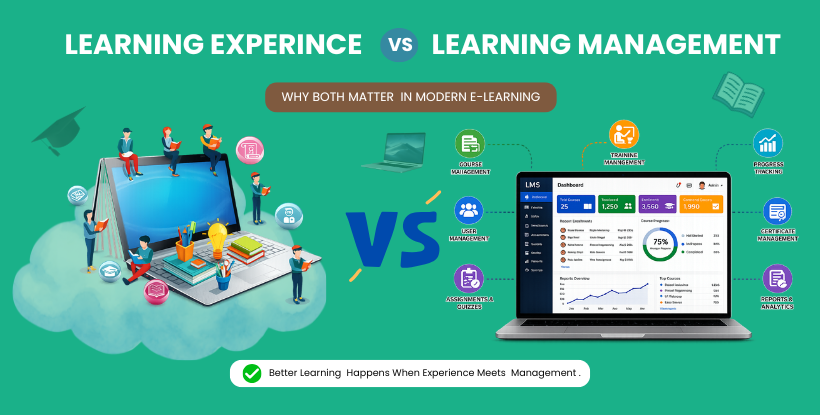
Learning Experience vs Learning Management: Why Both Matter in Modern E-Learning?
Successful online learning depends on more than simply delivering courses it requires both an engaging learner experience and effective course management. **Learning Experience (LX) focuses on how learners interact with content, instructors, and digital tools throughout their learning journey. It aims to make education interactive, personalized, and enjoyable. Learning Management (LM) , in contrast, focuses on organizing, delivering, monitoring, and evaluating learning programs through a Learning Management System (LMS)
Although these concepts have different objectives, they complement one another. Learning Management provides the structure and administration needed to run training programs efficiently, while Learning Experience ensures learners remain motivated, engaged, and able to achieve better learning outcomes.
What Is Learning Experience (LX)?
Learning Experience (LX) refers to the quality of a learner's journey from the moment they enroll in a course until they complete it. It emphasizes how learners feel, interact, and progress throughout the learning process rather than simply focusing on delivering educational materials.
A positive learning experience is often supported by features such as:
* Clear and user-friendly course navigation
* Interactive videos, quizzes, and simulations
* Customized learning paths based on individual needs
* Immediate feedback after assessments
* Group discussions and collaborative learning
* Learning from any device, including smartphones and tablets
* Gamification elements like points, badges, and achievement levels
The purpose of Learning Experience is to create an environment where learners stay engaged, participate actively, and retain knowledge more effectively.
What Is Learning Management?
Learning Management is the process of planning, administering, and monitoring educational or training activities. It enables instructors and administrators to manage every stage of the learning process while ensuring courses are delivered consistently and efficiently.
Typical Learning Management responsibilities include:
* Developing and organizing course content
* Registering and managing learners
* Scheduling lessons and assignments
* Tracking attendance and learning progress
* Conducting online tests and examinations
* Issuing certificates after course completion
* Producing reports and performance insight
These activities are generally handled through a Learning Management System (LMS), which automates administrative tasks and improves overall training efficiency.
Why Are Both Essential?
Many organizations invest in an LMS expecting it to solve every learning challenge. However, managing courses effectively is only one part of successful online education. Learners also need an engaging and meaningful learning experience.
Without a strong Learning Experience:
* Learners can quickly lose interest.
* Course completion rates may decline.
* Information is less likely to be retained.
* Overall satisfaction decreases.
Without proper Learning Management:
* Course administration becomes difficult.
* Tracking learner progress becomes inconsistent.
* Reporting and certification require more manual effort.
* Administrative teams spend more time on routine tasks
Combining both Learning Experience and Learning Management creates a learning environment that is efficient for administrators and rewarding for learners.
How Modern LMS Platforms Bring Both Together?
Modern LMS platforms are designed to support both administrative management and learner engagement. They combine operational tools with interactive learning features to create a complete digital learning ecosystem.
Common LMS capabilities include:
* Personalized dashboards
* AI-driven learning recommendations
* Interactive quizzes and assignments
* Gamification tools
* Discussion forums and peer collaboration
* Mobile learning accessibility
* Learning analytics and performance tracking
* Automated alerts, reminders, and notifications
Together, these features improve learning quality while reducing administrative workload.
Advantages for Educational Institutions and Businesses
Organizations that balance Learning Experience with Learning Management can achieve several benefits, including:
* Higher learner engagement
* Better course completion rates
* Reduced administrative workload
* More personalized learning experiences
* Accurate tracking of learner performance
* Improved knowledge retention
* Data-driven decision-making through analytics
* Easier expansion of training programs
Best Practices for Combining LX and LM
To achieve the best results, organizations should:
1. Design courses with learners' goals and preferences in mind.
2. Break lessons into short, engaging modules.
3. Use interactive assessments with instant feedback.
4. Regularly monitor learner performance.
5. Offer flexible and personalized learning paths.
6. Ensure all learning materials are mobile-friendly.
7. Analyze learning data to improve future courses.
8. Collect learner feedback and continuously enhance the learning experience.
Conclusion
Learning Experience and Learning Management are two equally important elements of successful digital education. Learning Management ensures courses are organized, delivered, and monitored efficiently, while Learning Experience focuses on creating engaging, personalized, and meaningful learning journeys.
Organizations that integrate both approaches through a modern LMS can improve learner satisfaction, increase completion rates, simplify administration, and deliver more effective online education. Rather than choosing one over the other, the greatest value comes from using Learning Experience and Learning Management together to create a complete and successful e-learning environment.