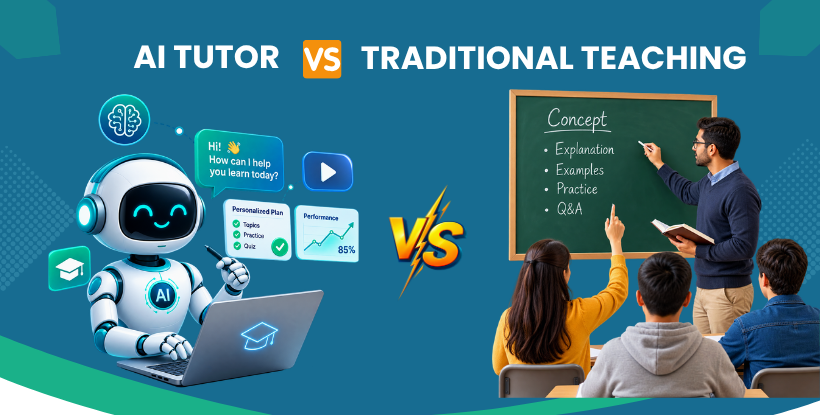
AI tutors and traditional teachers have different strengths, but modern LMS platforms can combine both to create personalized and effective learning. AI tutors provide instant explanations, practice, feedback, and anytime support, while teachers provide mentorship, motivation, critical thinking, and human guidance.
AI does not need to replace teachers. Instead, an LMS can use AI for repetitive tasks and learning support while teachers continue to guide students and make important educational decisions.
What Is an AI Tutor?
An AI tutor is an AI-powered learning assistant that helps students understand lessons, answer questions, practice topics, and receive immediate feedback.
It can:
* Answer questions
* Explain difficult topics
* Create practice questions
* Provide feedback
* Recommend learning resources
* Identify learning gaps
However, AI cannot fully understand a student's emotions, personal situation, or classroom experience like a teacher can.
What Is Traditional Teaching?
Traditional teaching focuses on direct interaction between teachers and students. Teachers explain concepts, monitor progress, provide motivation, encourage critical thinking, lead discussions, and offer personalized guidance.
Teachers can also understand when students are confused, frustrated, or struggling—something AI cannot completely replicate.
AI Tutor vs Traditional Teaching?
AI is mainly useful for speed, personalization, instant feedback, and repetitive learning activities. Teachers are essential for human interaction, motivation, emotional support, critical thinking, and educational judgment.
For example, AI can identify a topic a student struggles with and provide practice, while a teacher can understand why the student is struggling and decide how best to support them.
Therefore, AI and teachers should complement each other rather than compete.
How LMS Platforms Combine AI and Teaching?
A modern LMS connects AI-powered learning with teacher-led education.
Personalized Learning
The LMS can analyze course progress, quiz results, and learning activities to identify student needs.
Quiz → LMS identifies learning gap → AI provides support → Student practices → Teacher reviews progress
Teacher Control
Teachers can review AI-generated content, learning recommendations, assessments, and student progress. This keeps educators involved in important learning decisions.
Automated Tasks
AI can assist with FAQs, quiz creation, basic explanations, practice activities, and routine feedback, allowing teachers to focus more on meaningful instruction.
Learning Analytics
LMS analytics help teachers identify students who are progressing well and those who may need additional support.
Benefits:
* Personalized Learning – Support based on individual needs
* Instant Feedback – Faster responses to learning activities
* Teacher Productivity– Less repetitive work
* 24/7 Support – Learning assistance anytime
* Better Monitoring – Easier progress tracking
* Flexible Learning– Students can learn at their own pace
Challenges
AI tutors may face challenges such as incorrect information, over-reliance, data privacy concerns, limited human connection, and reduced critical thinking if students depend on AI for direct answers.
Therefore, AI should be used as a support tool rather than a replacement for teachers.
Future of LMS
The future of LMS platforms is based on human-AI collaboration:
Students Learn → AI Supports → LMS Analyzes → Teacher Guides → AI Personalizes.
AI provides personalization and instant assistance, the LMS manages learning data and progress, and teachers provide guidance, judgment, motivation, and human connection.
Conclusion
AI tutors and traditional teaching are not competing approaches. AI provides personalization, speed, and instant support, while teachers provide mentorship, motivation, critical thinking, and human connection. By combining both through an LMS, education can become more personalized, flexible, and effective.